

A good nasal aspirator should quickly clear a stuffy little nose and do so in a predictable way.
Nosiboo Pro It is a Class IIa stationary medical device designed to remove nasal secretions from children. Its design combines adjustable suction, high airflow, the patented Colibri head, two nasal tips, and operating parameters tailored for pediatric home use.
If you're here because your infant or child has a stuffy nose today, what you need most are practical answers: how to properly suction secretions, how long the suctioning process takes, how to choose the right tip, and what to expect from the device. We also explain where the Pro's size and price come from, what "500 W" means, how an air purifier differs from a vacuum cleaner, how Colibri works, and what the available studies show.

Nosiboo Pro is a medical device with its own operating characteristics, and its size and price are determined by the entire system.
The maximum motor power is 500 W, the adjustable operating power is 150–390 W, the pressure differential is 0.04–0.08 bar, and the maximum air flow is 30–42 l/min. Together, these parameters describe how the suction unit transports air and secretions through the head.
The body weighs about 1,090 g and measures approximately 198 × 162 × 172 mm. Inside, there is a mains-powered suction unit, a ventilation system, and a thermal protection device. It is this architecture that gives the Pro its desktop-like nature.
This is a medical device. Use it according to the instructions for use or the label.
We often think of a suction device as a small vacuum cleaner. In practice, it was designed for a completely different purpose.
This association comes up very often because, in both devices, the motor drives the airflow. However, the pediatric aspirator is designed to work with small noses, short aspiration cycles, and controlled transport of secretions. The pressure difference initiates the flow, and the entire airflow path gives it its characteristic behavior.
In a pediatric device, however, a very specific operating range is important. The Nosiboo Pro combines an adjustable pressure differential of 0.04–0.08 bar with a flow rate of 30–42 l/min and the geometry of the head, nozzle, and hose. It is this entire system that determines how the secretion is transported from the nose to the Colibri head.
The engine creates operating conditions. The entire airflow path transforms them into effective suction.
Negative pressure creates a pressure difference that sets air in motion. Flow rate refers to the amount of air moved per unit of time. The nozzle, head, and hose give this jet a specific shape. Therefore, it is best to consider the exhaust fan's specifications as a single system, rather than reducing its performance to a single number.

The size of the Nosiboo Pro meets the requirements of a stationary device designed to maintain the set operating parameters throughout the entire treatment.
The Pro weighs about 1.09 kg and operates on a 230 V / 50 Hz power supply. This housing contains a full-size suction unit, an air duct, a ventilation system, and thermal protection. The size of the device is determined by its function: maintaining a set level of negative pressure and flow for the duration required to perform aspiration while maintaining the proper thermal conditions.
The manual specifies approximately 10 seconds of contact per nostril. The device's full technical cycle can last up to 15 minutes, after which the manufacturer estimates a cooling time of approximately 50 minutes. This provides a significant margin compared to a typical, short procedure and, at the same time, explains the design of the body.
The housing also serves a thermal function. The manufacturer specifies an average housing temperature of 30–35°C after one minute of continuous operation and a thermal cutoff activation temperature of 95°C. Making the device smaller would require changes to the architecture of the suction unit, the cooling system, or the operating characteristics—which is why, at Pro, we treat size as a design element rather than a decorative feature.
The 3D model clearly illustrates why the vacuum value alone tells only part of the story.
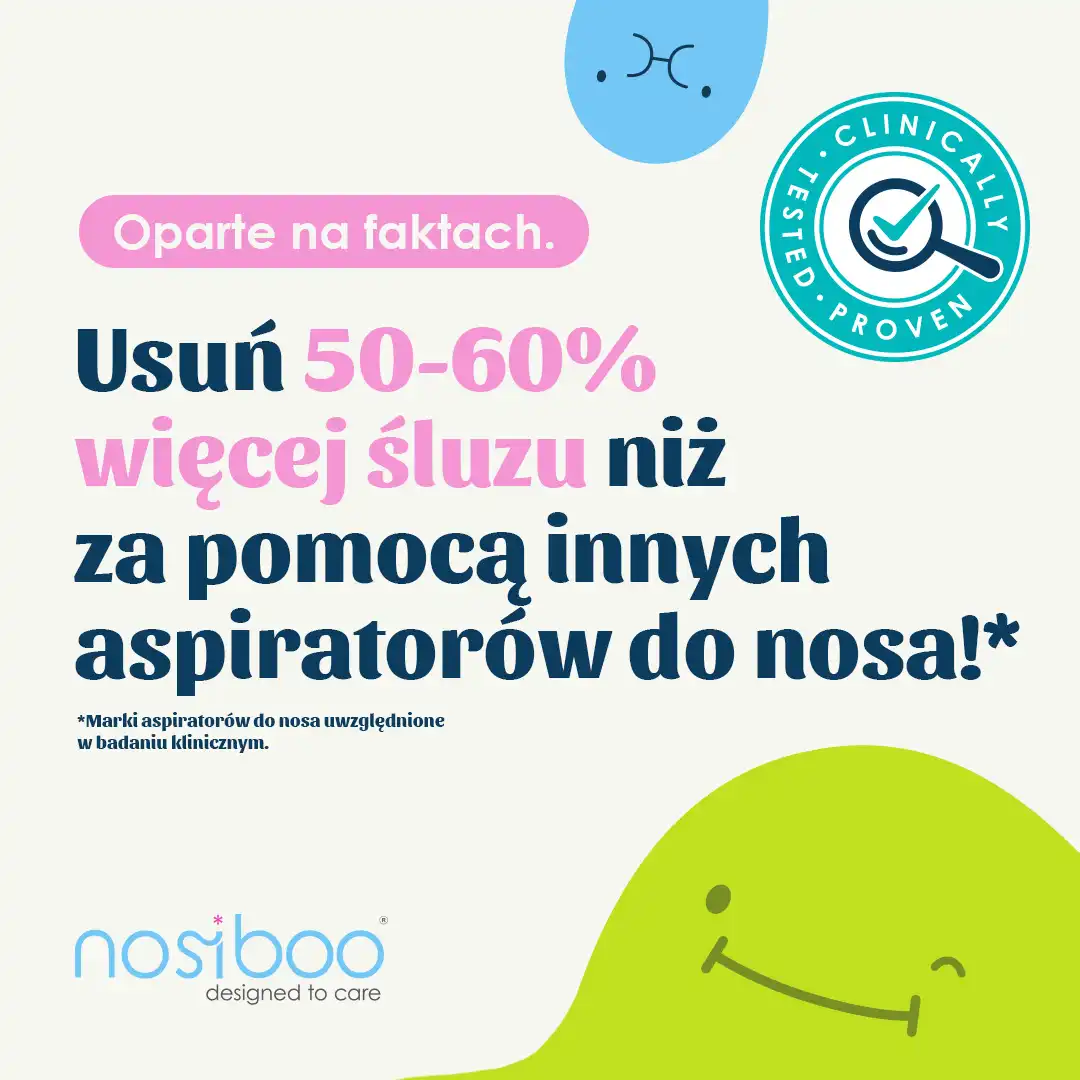
According to the manufacturer's public summary of a preclinical study conducted on a 3D anatomical model of the nasal cavity, the Nosiboo Pro removed an average of 83% of the sample. The two reference devices achieved 39% and 42%, respectively. This experiment is primarily intended to demonstrate the mechanics of secretion transport under various operating conditions of the devices.
The result applies to model conditions. Our conclusions regarding use in children are based separately on clinical data involving patients.
Studies involving children assessed nasal patency, aspiration tolerance, and the course of infection.
Rhinomanometry showed an improvement in airflow through the nose.
The study included 49 children aged 6 months to 6 years with a runny nose and nasal congestion. Efficacy was assessed, among other methods, using rhinomanometry, which is an objective measurement of airflow and resistance in the nasal cavity.
According to the manufacturer's public summary, aspiration was successfully performed on all 49 participants, and measurements showed an improvement in nasal patency. The safety summary reports 0 cases of nosebleeds and 0 reported adverse reactions from the listed list. The results describe this specific group of children and the protocol used.
The second study tracked the course of an acute upper respiratory tract infection.
The manufacturer describes QP21-NO10 as a “prospective, randomized, observational study that does not require intervention”. Fifty children took part in it. In the group that underwent suction, the recovery rate was 88%, compared with 56% in the control group. The manufacturer's public summary reports a statistical significance of p=0.025.
The conclusion applies to this population of 50 individuals and the protocol described. The effect in a particular child depends on the course of the infection, how the device is used, and individual medical recommendations.

The soft tip is made of a specific material and has a specific size and shape tailored to the child's age.
Official Nosiboo materials indicate that the soft tip in the Colibri head is made of a material BPA-free. The manufacturer also states that it uses materials that are harmless to humans.
The manual also specifies the dimensions of the part inserted into the nozzle. The neonatal tip has a maximum diameter of 4.9 mm and a contact length of 12.6 mm, while the standard tip has a maximum diameter of 7.0 mm and a contact length of 8.0 mm, respectively.
The discharge flows into the head, and the cleaning zone remains straight.
Colibri's patented design is engineered so that the suctioned secretions remain in the head. This limits the number of components that the parent unit handles after the procedure and separates the contact area from the device's body.
After use, disassemble the head, wash its contact parts with lukewarm water and dish soap, and let them dry completely. An air-mesh insert at the opening of the housing protects the device from solid particles and dust.
How to Use Nosiboo Pro for a Runny Nose in Infants and Older Children?
Newborn nipple and lower adjustment range. For a newborn, the instructions indicate contact at the entrance to the nostril.
Standard tip. The intensity can be increased as the child gets older and depending on the thickness of the secretions.
The manufacturer recommends approximately 10 seconds of contact aspiration for each nostril.
The instructions allow for repeated use throughout the day and specifically mention the time before bed and before feeding.
A mild salt solution can help thin it out. The instructions call for a break of a few minutes before performing another aspiration.
Situations Requiring Consultation or Withdrawal from Aspirations
The manufacturer's manual lists m.in. hemophilia, frequent nosebleeds, treatment with blood-thinning medications, congenital defects such as cleft palate, and wounds, inflammation, or active bleeding inside the nose.
This is a medical device. Use it according to the instructions for use or the label. The attending physician's recommendations take precedence in each child's individual situation.
The price is determined by the entire system: mechanics, medical application, testing, contact materials, and consumable parts.
Inside, there is a stationary suction unit equipped with controls, ventilation, and thermal protection. The patented Colibri head, featuring two age-specific tips, is used on the child. The entire product is classified and regulated as a Class IIa medical device, and the manufacturer operates under an ISO 13485 quality management system..
The product's value is enhanced by clinical trials, technical documentation, European manufacturing in Hungary, and the availability of consumables. In practice, the Nosiboo Pro is a device designed for the upcoming flu seasons during a child’s first years of life.
This noise level is specified in the manual. The sound of the vacuum unit operating is clearly audible.
The manufacturer states that the expected service life of the housing's electrical components is 3 years. This is a technical specification, separate from the warranty period. The warranty period is specified in the terms of sale, warranty documents, and applicable regulations.
The manual states that the expected service life of the print head is 3 months. The available replacement parts help keep the system in proper working order.
Pro is best suited for home use. If portability is a top priority for you when traveling, it’s worth carefully comparing it to the category of portable aspirators.
The greatest value of Pro is its reliability when parents need a solution that works best.
Parents adjust the intensity based on the child's age and the type of discharge, and the device operates within its designed range. During the flu season, this predictability is more important to us than the number of additional features.
The Nosiboo Pro is particularly well-suited for families who want a single stationary nasal aspirator for their home and plan to use it during their child’s subsequent illnesses throughout the first few years of the child’s life.
We've known Nosiboo since it first appeared in Poland.
3kiwi was the first company in Poland to introduce Nosiboo to the Polish market. We remain the brand's longest-standing partner in Poland and an authorized retailer of Nosiboo products.
At 3kiwi, the nasal aspirator category is built exclusively around Nosiboo—we deliberately do not include other brands of nasal aspirators in it. Thanks to this, we're familiar with the Pro model from subsequent years of sales, parents' questions, wear-and-tear parts, everyday use, and after-sales service. This article combines the manufacturer's documentation with experience gained from actual use of the product.

European Manufacturing and Quality System for Medical Devices.
The manual identifies Attract Kft. as a manufacturer of medical devices operating under the ISO 13485 standard. Nosiboo Pro is a Class IIa medical device with the EUDAMED manufacturer identifier HU-MF-000004252.
The technical documentation includes m.in. Protection Class II, BF-type applied parts, IP21 rating, and electromagnetic compatibility in accordance with the specified IEC/EN 60601 standards.
View the medical suction devices category →Nosiboo Pro — The Most Important Answers in One Place
Is Nosiboo Pro suitable for a newborn??
How often can you use a suction device??
What does 500 W mean in the Nosiboo Pro??
Why is the Nosiboo Pro larger than a portable nasal aspirator??
Does a suction device work based on the same principles as a vacuum cleaner??
What Clinical Trials Show?
What does a score of 83% mean on the mock test??
Is the tip BPA-free??
How long does a single aspiration take??
Is Nosiboo Pro worth the price??
Technical data, research, and sales experience have been separated.
We base the device's specifications, instructions for use, contraindications, medical device status, and cleaning guidelines on the manufacturer's instructions. The study data are taken from the public summaries QP21-NO09, QP21-NO10, and QP21-NO11 provided by the manufacturer. 3kiwi sells Nosiboo Pro; our analysis of the product’s dimensions, utility, and frequently asked questions is our editorial content.
Nosiboo Documentation → Clinical Trials → Manufacturer's FAQ →3kiwi does not grant permission to copy, publish, or commercially use the copyrighted content of this publication, including text, graphics, illustrations, photographs, and editorial layout. Technical data, instructions, and source materials provided by the manufacturer retain the status assigned to them by their sources.