

This is a project about life around the table—from the earliest days through adulthood.
Is the Stokke Tripp Trapp Worth Buying?? After fifteen years of working with the brand, selling thousands of chairs, and seeing them in real homes, our answer is clear: Yes—if you're looking for a piece of furniture that will grow with your child from the very first days of life through to when they can sit on their own, through school, into their teenage years, and beyond.
Tripp Trapp has created a whole new product category: a children's chair designed with adulthood in mind. This guide explains what makes it stand out, how 4-in-1 and 3-in-1 sets really differ, when you need a Newborn Set, why an adjustable footrest is useful, and what you should know before buying—including things that only become apparent with everyday use.

Is the Tripp Trapp worth its reputation?? Yes—but for the right reason.
Its advantage stems from the entire system: The same wooden structure can take on completely different roles while retaining its own identity. With the Newborn Set, it becomes a space for a baby at table height. With the Baby Set and tray — a high chair for first meals. Later, it becomes an adjustable piece of furniture for a table or desk. In the end, it just looks like a good chair.
That is precisely why, after more than half a century, Tripp Trapp is still relevant today. The user and setting change. The project itself remains.
Six Things You Need to Understand Before Buying.
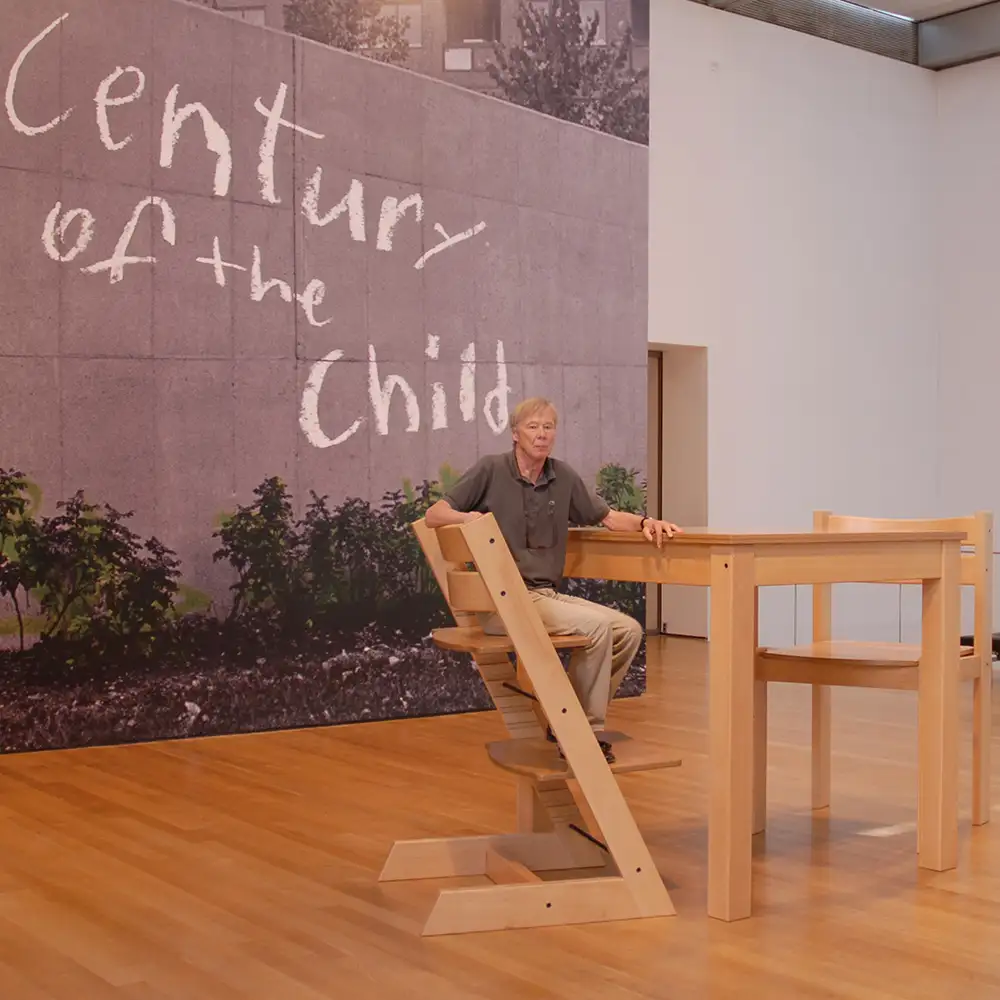
Peter Opsvik focused primarily on designing a place for children at the table.
Tripp Trapp was created in 1972 to address a very simple problem: a classic adult chair is proportioned to fit an adult’s body, while a child needs a different height, depth, and stable footrest. A typical high chair solves this problem only temporarily. Opsvik turned the logic on its head: instead of designing a piece of furniture tailored to a specific age group, he created a frame that allows you to adjust the position of the seat and footrest.
This allows the child to have their own portion at the adult table. It's at the right height, has room for your feet, and can be part of the same ritual as the rest of the family. That single design decision gave rise to a category that modern adjustable chairs still belong to today.
One chair. Four Moments in Life.
The easiest way to understand Tripp Trapp is by looking at the different stages of use, because each element of the system corresponds to a specific stage of development.
These are three points of entry into the same system.
The best choice if you're starting while you're still pregnant.
Chair + Newborn Set + Baby Set + tray. It allows you to take advantage of the Tripp Trapp concept from the very first days of life and then seamlessly transition to introducing solid foods.
See the Tripp Trapp 4-in-1 →The most logical place to start when expanding your diet.
Chair + Baby Set + Tray. This setup is for the stage when a child can already sit up on their own and remain stable.
See the Tripp Trapp 3-in-1 →The perfect choice for older children, students, and the home.
For an older user who is already moving on to the final version of the chair. What remains is the essence of the design: wood, geometry, and the adjustable seat and footrest.
See the chair itself →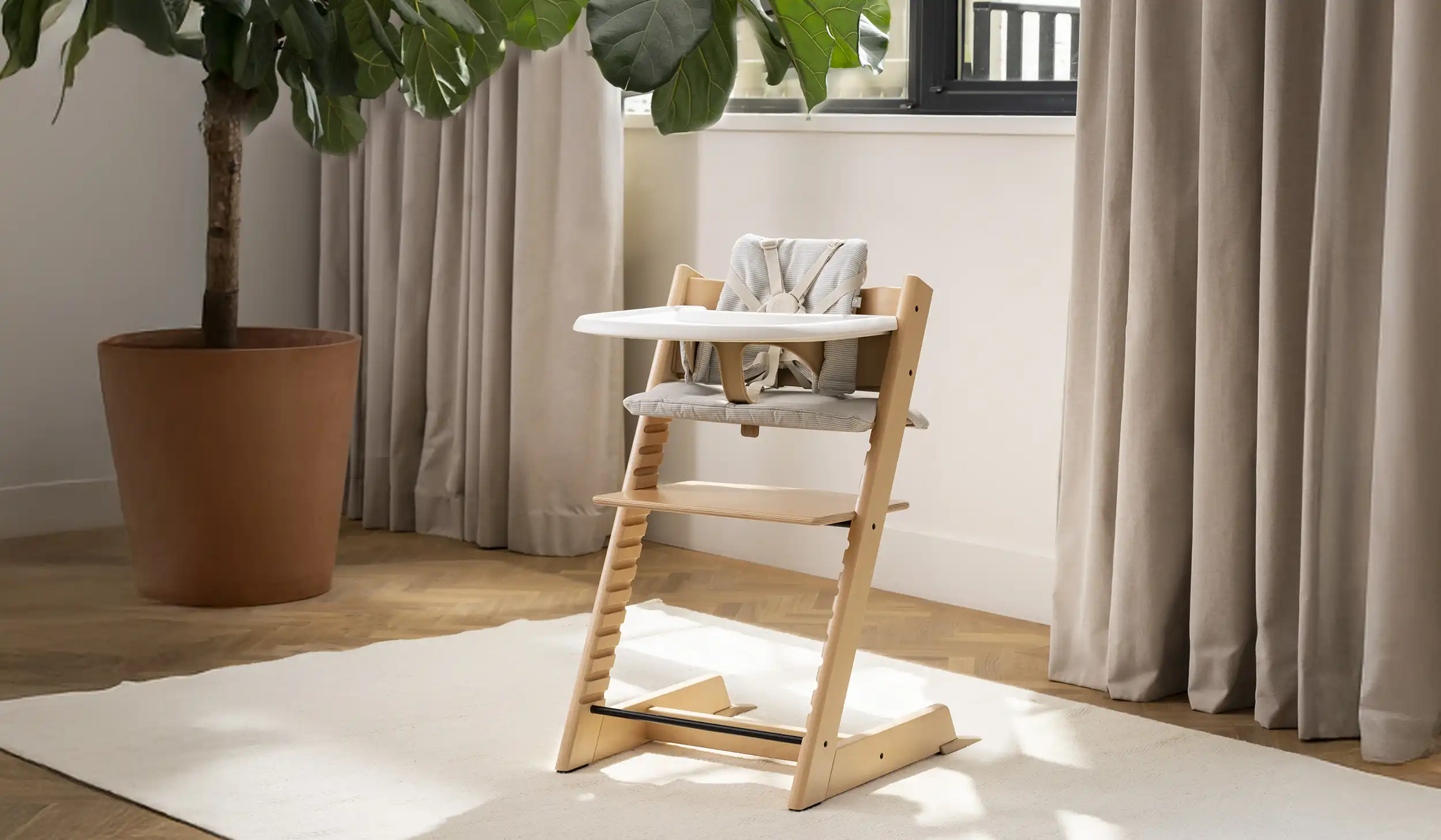
The biggest advantage of the 4-in-1 version becomes apparent before the child can sit up on their own.
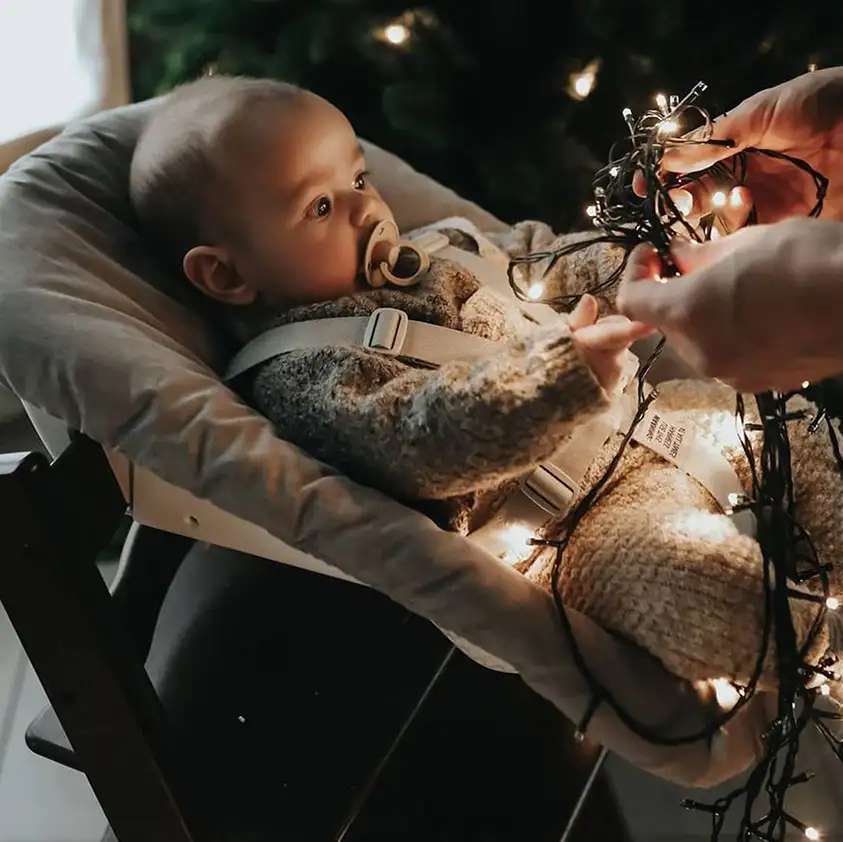
The Newborn Set lifts the infant from floor level to table height. From a parent's perspective, this means easier eye contact and having the child present in a place where much of family life takes place anyway. From the perspective of the entire project, this is a logical extension of Opsvik's idea: The child should be near the family table even before they can sit up on their own.
The manufacturer recommends the Newborn Set for infants up to about 6. months and up to 9 kg; this stage ends earlier if the child begins to sit up on their own. This is a semi-reclining cradle for staying awake and bonding. A separate, safe sleeping area that complies with infant sleep guidelines is provided for the child to sleep in.
Expanding one's diet is a stage. A shared table is an idea.
Once the baby can sit up steadily, the Baby Set cradles the baby from behind and on the sides, creating a safer and more comfortable space for the baby’s first meals. Your hands remain free, and the seat height and footrest can be adjusted to accommodate a growing user.
The tray is very practical: it provides a separate surface for eating, and it's easy to remove and wash. Its role is practical, while the shared table remains the philosophical heart of the Tripp Trapp. Opsvik designed the chair so that the child would eventually be able to sit at the shared table. The tray serves as both a stage and a practical tool, while the chair itself, placed at the communal table, remains the final form of the system.
The footrest is just as important as the seat.
The most distinctive feature of the Tripp Trapp is the ability to adjust seat height and depth, and footrest position. This allows the chair's proportions to adjust to the user.
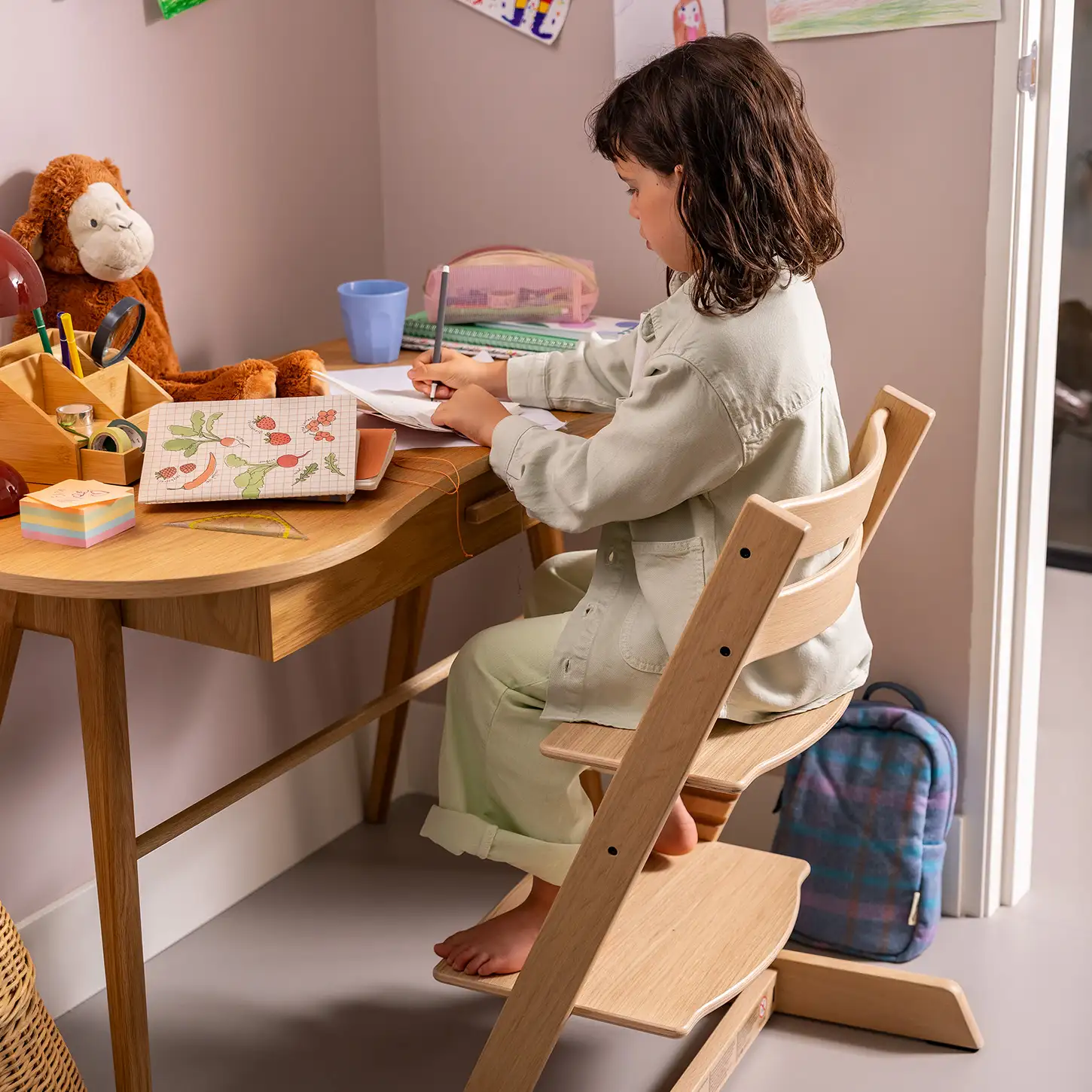
For a small child, having stable support for their feet makes for a completely different sitting experience than having their legs dangling. For a student, the same geometry can be positioned relative to the desk. For teenagers and adults, the footrest slides further back until the chair functions like a regular piece of furniture.
It is precisely this feature that makes “grows with the child” a literal description of the design.
The greatest luxury of this product? It stays inside as the child grows up.
Many children's products are designed very specifically for a short stage. Later, their function and aesthetics fade away together. Tripp Trapp takes the opposite approach: the fewer accessories an older child needs, the more the chair's clean lines stand out.
At the table, at the desk, while drawing and studying, and later as an extra seat for a family member or guest — The design remains necessary thanks to its neutral, furniture-like form.

Form arises directly from function.
The side structural elements, distinctive profile, horizontal seat, and footrest—the Tripp Trapp is recognizable from several meters away, just by its silhouette alone. Peter Opsvik's design has become an icon of Scandinavian industrial design precisely because its appearance stems from the way the chair functions.
For more than half a century, the form has remained virtually unchanged. Stokke changes colors, woods, finishes, and limited-edition collections, but the core of the design remains instantly recognizable. This is a very rare example of a children's product that serves both as an everyday tool and as an object of design.
Beech and oak define the chair's structure and visual character.
Tripp Trapp is available in beech and oak finishes. Natural wood gives the structure rigidity, the ability to be adjusted over many years, and a different aging process than that of a chair made primarily of plastic. The grain pattern also means that two pieces with the same coloration may differ slightly from one another.
In painted versions, the material's texture remains visible beneath the paint. In oak, it becomes an even more striking visual element. That's why, when it comes to the Tripp Trapp, the question "what color?" is, in fact, often a question about the character of the wood and how the piece of furniture will fit into a specific interior.

Things we show customers in the showroom instead of sweeping them under the rug.
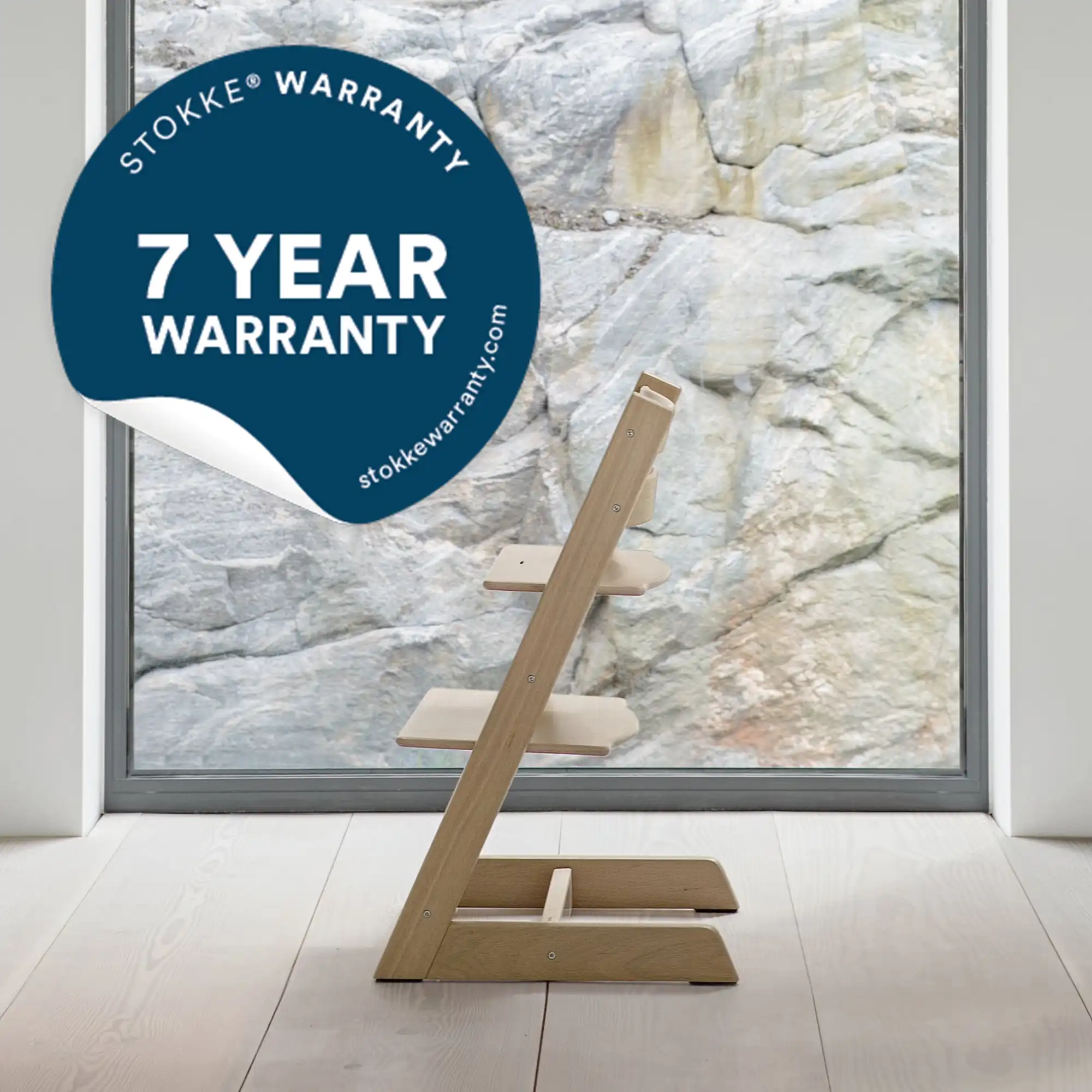
Up to a 7-year warranty after registration.
Each chair has its own serial number. Stokke offers an extended warranty of up to 7 years for manufacturing defects after the product is registered in accordance with the manufacturer's terms and conditions.
For a product designed for such a long service life, it plays a role that is inconsistent with its logic: The chair is designed to last long after the Baby Set phase is over.
Engraving, limited-edition finishes, simpler packaging.
The Tripp Trapp has a feature that’s rare for a children’s product: it lends itself well to personalization and a collector’s approach. Stokke periodically offers special finishes, and engraving on the backrest is available for select configurations. That makes sense precisely because the product is meant to stay in the home for a long time.
Starting in mid-2025, Stokke also switched to simpler, reinforced kraft packaging for its Tripp Trapp collection. It's a small detail, but it fits well with a product whose value lies in its materials, functionality, and long-term use..
Fifteen Years with Stokke Is Changing the Way People View the Tripp Trapp.
We have been working with Stokke since 2011. We've sold thousands of Tripp Trapps; we use them ourselves, and we see the product both on the day of purchase and years later—when customers come back for a second one for their next child, another accessory, or simply to show us the chair that's still in their kitchen.
That is why our assessment is so unequivocal. Tripp Trapp's greatest strength is its precision in fulfilling its original purpose: it remains a good chair even after the features typically intended for children are no longer needed.
It's one of the few things in the children's industry that can actually make the transition from the "we're buying this for our child" stage to the "this is just our chair" stage..

The best way to understand it is to sit on it.
At the 3kiwi showroom in Wrocław, we have the Newborn Set, Baby Set, tray, and the final version of the chair on display side by side. You can compare beech with oak, see how the adjustment works, and check how the same design works for a small child and for an adult.
Visit the 3kiwi store →Tripp Trapp remains the benchmark for the entire category.
Half a century later, the market features more functions, faster adjustments, foldable designs, and new materials. And yet, Tripp Trapp still stands by its most challenging promise: to remain necessary throughout many stages of life.
For a family getting started even before the baby is born, we would choose the 4-in-1. When expanding your diet — 3-in-1. For an older child — just the chair. In any case, you're buying the same design by Peter Opsvik and the same logic: Adapt the furniture to the person, rather than changing the person or the furniture at every stage.
If you're looking for the most classic, proven, and durable system in the premium segment, Tripp Trapp is still the first product to consider when making a comparison.
In a separate report by the 3kiwi Academy, we compare the Tripp Trapp, Cybex Click & Fold, Stokke Steps, and the award-winning LEMO Platinum—as four different solutions to the same design challenge.
Premium High Chairs – 3kiwi Guide →The system evolves as the child grows — the instructions matter, too.
The Newborn Set should be used only as intended and discontinued once the child begins to sit up on their own. A separate, safe space is provided for the child to sleep. The Baby Set and other accessories should be used in accordance with the current instructions and the manufacturer's guidelines..
After each adjustment to the seat or footrest, be sure to tighten the structure properly. It's a good idea to periodically check the connections and the condition of the chair—especially after many years of heavy use.
Frequently Asked Questions Before Purchasing
Can the Tripp Trapp be used from birth??
Tripp Trapp 4-in-1 or 3-in-1?
When can you start using the Baby Set??
Is a tray necessary??
Does the Tripp Trapp really grow with your child??
Is it suitable for a desk??
Does the adjustment require tools??
Does the Tripp Trapp fold up??
Beech or oak?
Can it be used by a teenager or an adult??
How to Get a 7-Year Warranty?
The text combines Stokke's documentation with 3kiwi's experience gained from many years of selling and demonstrating the system in the showroom.. 3kiwi is a retailer of the Stokke brand; the links in the article also lead to our product selection. Ratings and recommendations are editorial decisions made by Akademia 3kiwi.
Documentation: Stokke Tripp Trapp Newborn Set — Instructions and Usage Limits • Stokke — Extended 7-Year Warranty • Stokke's Official List — 3 Kiwi Baby Shop Wrocław.
© 3kiwi 2026. Original editorial piece. Use of the entire text or significant portions thereof requires permission from 3kiwi.